
British Columbia Municipal Local Choice
Want to improve our local democracy in BC? Each community should be able to choose the voting system that works for them!
BC’s municipal elections often suffer from low levels of participation, unrepresentative outcomes, and poor representation of women, visible minorities and tenants.
Cities and towns across North America, most recently Portland Oregon, are using innovative methods to make their local elections more engaging, diverse and fair.
Our cities and towns in BC are prevented from making those choices. They are severely restricted by the Local Government Act.
BC Municipalities should be allowed to try new things, and customise their local elections based on local needs. Each BC municipality is unique and there is no “one size fits all” solution.
We call on the BC government to create enabling legislation that gives more choice to BC’s municipalities.
No municipality would be forced to change its system. This legislation would simply provide local councils with options, enabling them to open the door to local democratic renewal and to choose the system that best fits the unique needs of their community.
Learn more about municipal electoral reform in BC
In 2017, Vancouver’s Independent Election Task Force recommended proportional representation for Vancouver. They recommended that Vancouver establish a Citizens’ Assembly to determine the model, and that Vancouver request that the provincial government allow the City to adopt the PR model that the
Citizens’ Assembly recommended.
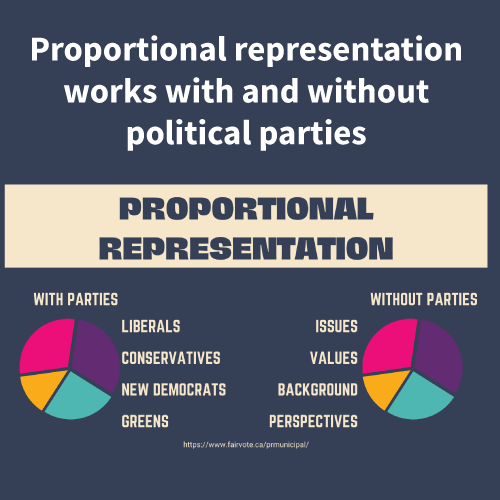
Many people think proportional representation (PR) only works in elections with political parties. In fact, PR aims to fairly represent the views in a community, and works in elections with and without parties. Learn more about municipal PR.
News, blogs and resources
Portland Oregon adopts proportional ranked choice voting
In an era of democratic decline, some cities are spearheading changes to empower voters and help restore citizens’ trust in government. Voters in Portland Oregon recently chose to adopt proportional ranked choice voting.
The Charter Commission’s recommendation was backed by forty local groups, including the Coalition for Communities of Colour, the NAACP, and Business for a Better Portland.

Flawed voting system leads to costly Surrey police saga
Doug McCallum won the Surrey mayor’s seat in 2018 with a lower share of the vote than when he lost to Dianne Watts in 2005. With that weak mandate his party was able to capture both the mayor’s chair and 7 of 8 council seats and bring in the Surrey Police Force without the support of any outside the 41% that voted for him and his party.
Now Brenda Locke and her majority on council, with just 28% of the votes for Mayor and a combined 25% of the votes for Council, are reversing McCallum’s decision at a cost of hundreds of millions.
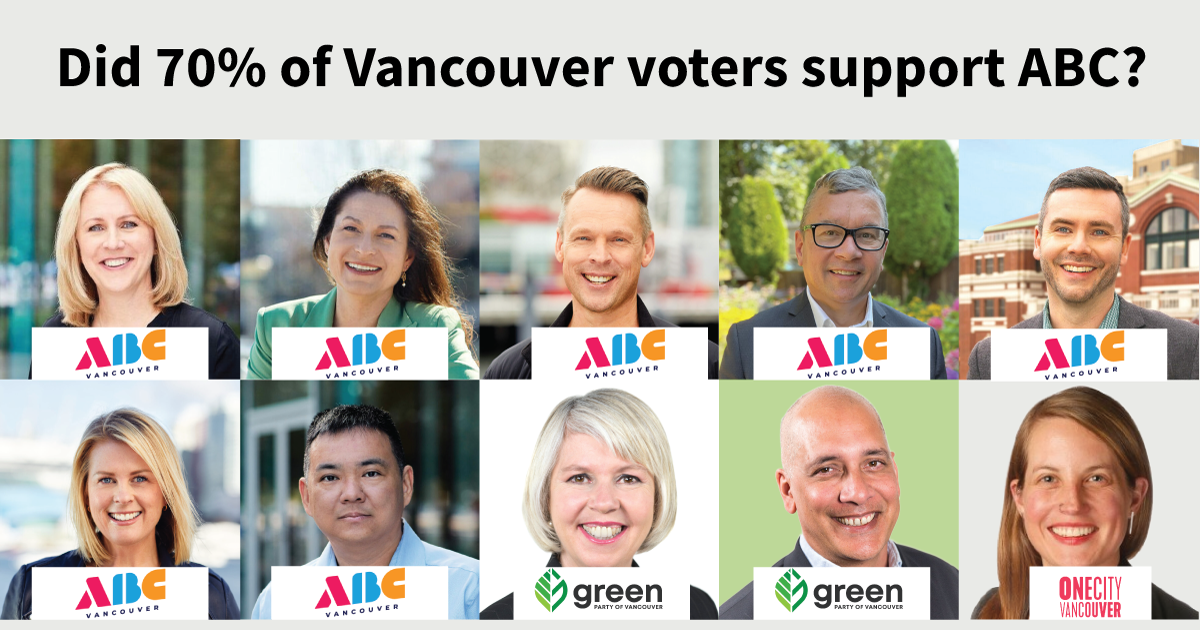
Winner-take-all bloc voting shut Vancouver voters out
With winner-take-all bloc voting, ABC Vancouver has been handed 70% of the seats on Vancouver Council―but did 70% of Vancouver voters intend to hand a single party control of every decision for the city? As political scientist Stewart Prest pointed out, “A a significant portion of the population that did not vote for ABC are left with very little to show for their votes.”
Voters for the Affordable Housing Coalition, COPE, Forward, NPA, Progress, Vision and Team, as well as Independent candidates, received 44% of the vote but were totally shut out.