
Electoral Reform for BC municipalities
Most municipalities in BC use at-large block voting – which is first-past-the-post for multiple at-large seats.
This does not produce a city council that reflects the diversity of the community.
Many people don’t realize that proportional representation can be used municipally, to elect city councils. Here’s why and how.
Isn’t proportional representation just for elections with parties?
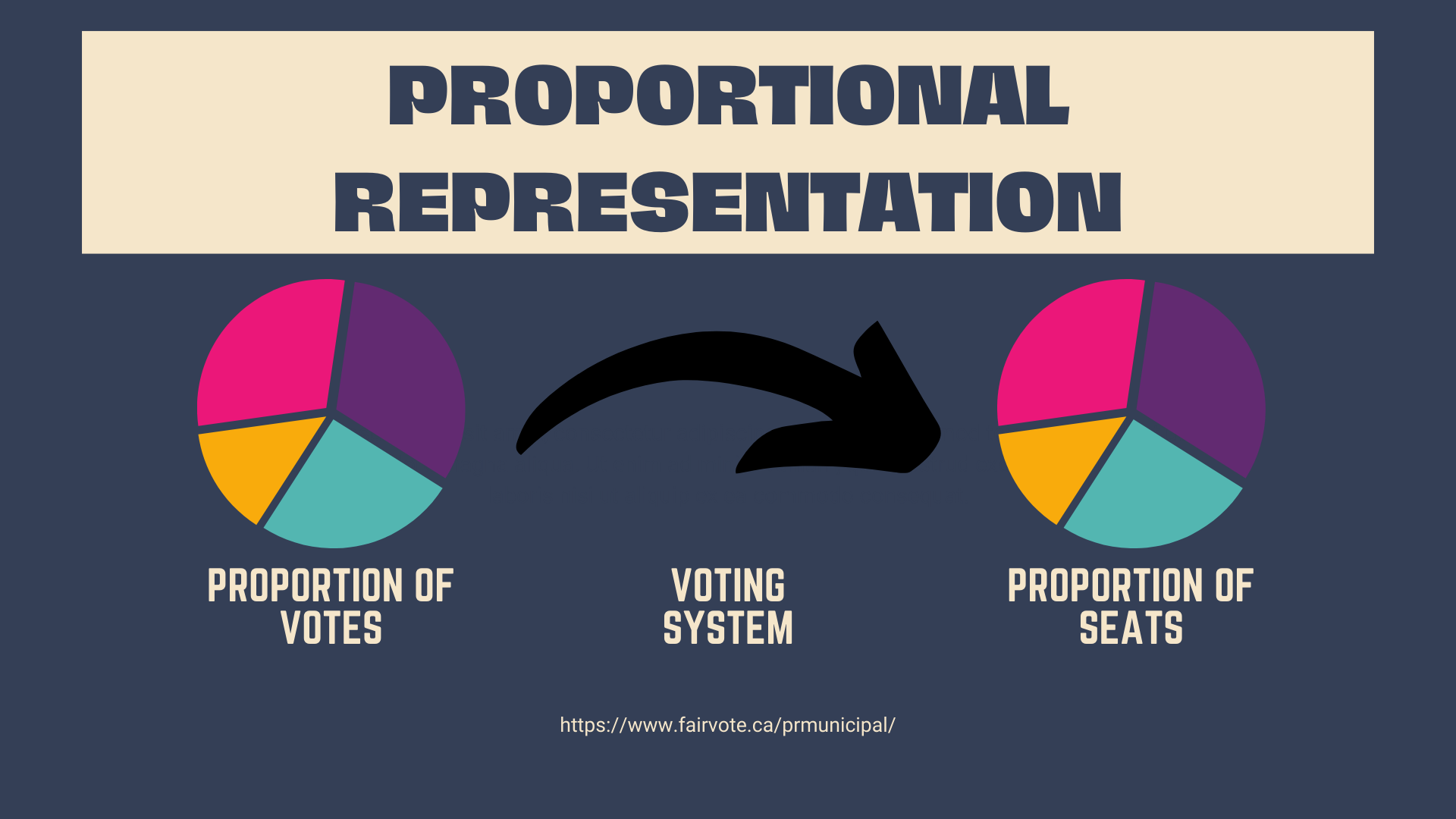
Many people think proportional representation applies only when there are political parties. 30% of the vote for Party A should mean Party A gets 30% of the seats. This is the easiest way to visualize PR for federal and provincial elections:
While Vancouver has parties at the local level, other BC municipalities do not.
Proportional representation works just as well to make every vote count and represent political diversity in elections without political parties.
This is because proportional representation is a principle: That an elected body (such a city council or a legislature) should accurately reflect the diversity of the community.
That every vote should count.
The original proportional representation system, proportional ranked choice voting (also known as Single Transferable Vote – PR-STV) was in use before political parties even existed, when voters with values and goals in common were not defined by party labels but still needed fair representation.

Representation of political and ideological diversity on local councils
Some people view municipal elections in cities without parties as refreshingly “non-partisan”. They look at their municipal representatives as ideally being independent local problem solvers.
While its true that in most cities there are no political parties, it’s also true that the candidates running for municipal councils are not ideology-free.
New research shows that Canadian city councillors tend to have partisan affiliations and/or ideology that matches the most popular partisan affiliation in the area they represent.
In other words, if voters in municipal ward A tended to vote for a right wing representative at the federal level, then the city councillor for that ward will also tend to be on the right of the political spectrum. Who represents the other voters?
Municipal politicians make important decisions where ideology and values become very important: about spending, housing, social welfare programs, land use and development, and more.
To use a concrete example, if 60% of voters in a municipality vote for candidates who run on increasing the supply of affordable housing, those voters should elect about 60% of the city councillors.
This simply does not happen with winner-take-all voting systems, where councillors with one position or political leaning can sweep a disproportionate number of seats, while those with others points of view can be under-represented.
Representation of ethnic diversity on local councils
Proportional representation better reflects all kinds of diversity in the community, too.
For example, the majority of residents of Metro Vancouver are not caucasian. Yet 79% of their municipal councilors are white. Research shows that proportional ranked choice voting has substantially improved diversity on city councils.
The repeal of proportional representation in many of the 24 US cities that once used it – including New York City – was driven by those with a racist agenda. Researcher Amy Douglas sums it up:
“While the repeal of STV in these American cities was taken as evidence by opponents that the electoral system had failed, it was probably more accurate to conclude that this system was rejected because it worked too well. STV worked too well in throwing party bosses out of government… More importantly STV worked too well in promoting the representation of racial, ethnic and ideological minorities that were previously shut out by the first-past-the-post system. The political successes of these minorities set the stage for a political backlash that was effectively exploited by opponents of STV.”
Currently, over 200 US jurisdictions currently use semi-proportional systems such as Cumulative Voting or Limited Voting at the local level, brought in to improve the diversity on city councils, often following court rulings that winner-take-all voting was shutting minorities out.
From the Sightline Institute:
“Many jurisdictions in the United States adopted either cumulative or limited voting in the 1980s and 1990s as a remedy for minority vote dilution under section 2 of the Voting Rights Act (VRA). In most cases litigation spurred the adoption. In these cases claimants showed that unmodified at-large voting systems diluted voting strength of people of color. People in the racial or ethnic minority made up a significant portion of the population but still had never, or almost never, elected a single representative, because majoritarian at-large elections allow voters in the majority to elect 100 percent of the representatives.”
a
Who is currently using proportional representation for their local elections?
Proportional ranked choice voting is used for local elections in all of Ireland, all of Scotland, and some cities in New Zealand (with more cities adopting it over the years). A different form of PR (Mixed Member Proportional) is used for local elections in London, England.
Cumulative Voting or Limited Voting (semi-proportional voting systems) are used in over 200 places in the US.
In 2022, voters in Portland Oregon chose to adopt proportional ranked choice voting! Portland becomes the seventh city in the US to use proportional ranked choice voting currently or who have recently adopted it for future elections. See how it works in the video at the bottom of this page.

The win for PR in Portland followed a recommendation by the Charter Commission, a group of 20 citizen volunteers appointed by Portland’s City Council. The Charter Commission spent a year researching and consulting citizens. They recommended proportional ranked choice voting as a way to make Portland’s elections more democratic and their government more responsive and effective.
The Charter Commission’s recommendation was backed by forty local groups, including the Coalition for Communities of Colour, the NAACP, Business for a Better Portland, and the Portland Association of Teachers.
How do we get municipal proportional representation in British Columbia?
Canadian cities must follow provincial legislation which outlines which kinds of voting systems are permitted at the municipal level. Currently, only winner-take-all systems (first-past-the-post and block voting) are permitted in each province, including in British Columbia.

Electoral reform activists in BC have been lobbying the province for local choice legislation off and on for decades.
Every municipality in BC already elects members at-large or in multi-member wards. If the province granted permission to cities to choose their own voting systems, any city which adopted “ranked ballots” in BC would be adopting proportional ranked choice voting.
There is the most momentum for the change in Vancouver.
In 2017, the Vancouver Independent Election Task Force recommended switching to proportional representation, the design of which would be chosen by a local Citizens’ Assembly.
In the most recent provincial election in BC, only the Green Party committed to push for cities to have the right to choose their own voting systems. Electoral reformers will continue to build coalitions and lobby the province for local choice.
Get Involved or Get More Information
Would you like to start pushing for municipal local choice in BC? Get in touch with Fair Vote Canada’s Municipal PR Liaison, Keith Poore, at keith.poore@fairvote.ca